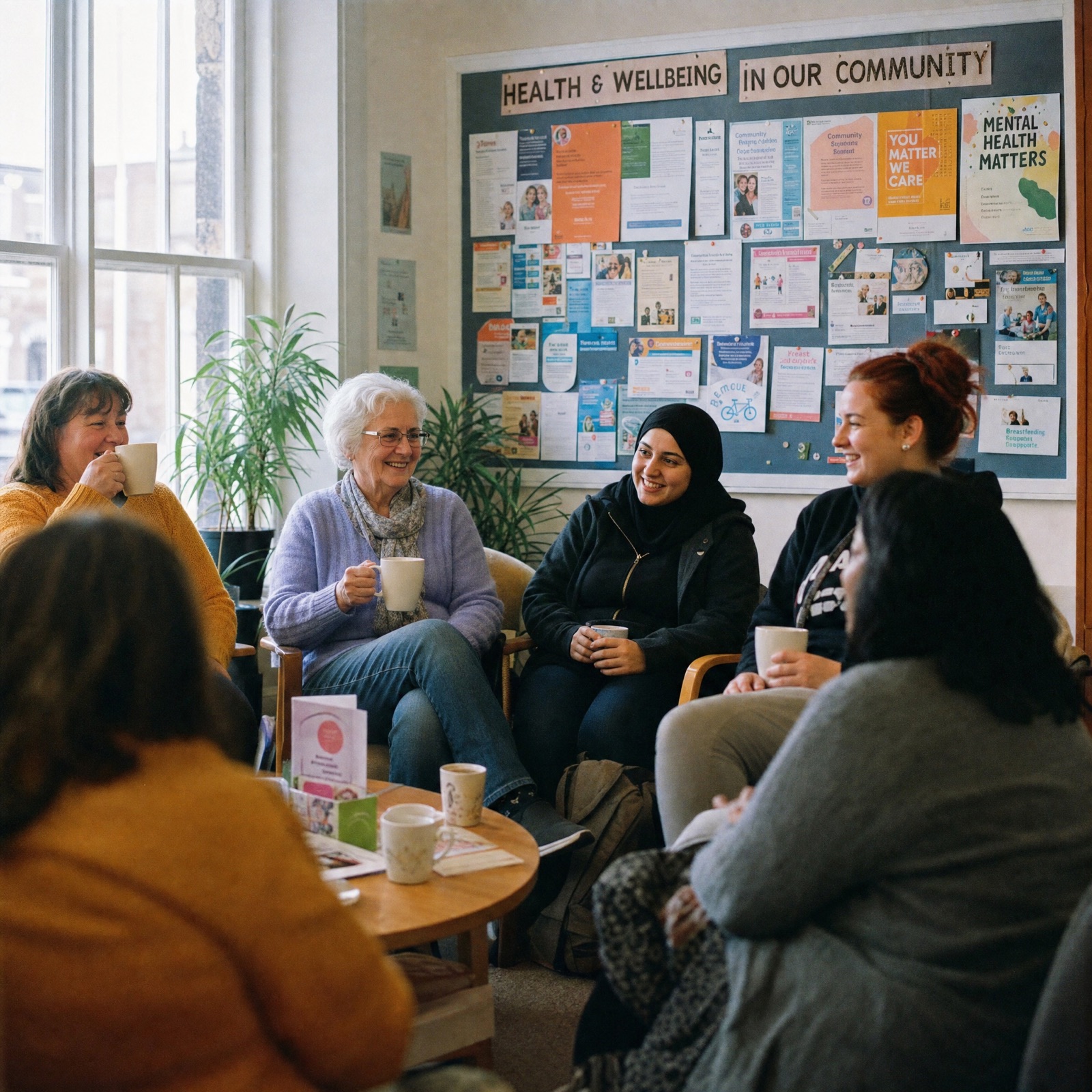
It's 7:45pm on a Tuesday when Daniel walks through the door of the community hall on the edge of Livingston's Oakbank Industrial Estate. He's still in his high-vis vest, steel-toe boots leaving a damp print on the linoleum. His shift finished twenty minutes ago. In the daytime, he'd have no chance of seeing a nurse or health advisor — his hours simply don't allow it. Tonight, though, someone is waiting for him.
Vibrant Health Advocates Orion runs evening and weekend drop-in sessions specifically designed for people like Daniel: shift workers, warehouse operatives, factory floor staff, and lorry drivers who power Livingston's sprawling distribution parks but are routinely locked out of conventional health services by the hours they keep. The session Daniel walks into is staffed by a trained health advisor who can discuss blood pressure readings, lifestyle concerns, sleep problems, and signpost to further services — all without an appointment, and all at a time that actually works.
The geography of West Lothian tells a particular story. Livingston grew up as a new town with industry at its heart, and today its distribution parks are among the busiest in Scotland, supplying supermarkets and online retailers across the country. Thousands of workers clock on in the late afternoon and leave well after midnight. For them, the standard Monday-to-Friday, nine-to-five model of healthcare provision is functionally useless — GPs, pharmacies, and wellbeing services close precisely when these workers are free.
Vibrant Health Advocates Orion was set up to close that gap. The organisation works from the understanding that access to health information is not just a matter of geography but of time. A service that opens at 9am helps nobody whose shift starts at 6am and ends at 2pm in the afternoon, and certainly not someone whose night shift runs from 10pm to 6am. By placing drop-ins in community spaces near industrial sites and running them in the evenings and on weekends, the team has created touchpoints that fit around real working lives.
At each session, attendees can pick up practical health information covering cardiovascular health, mental wellbeing, nutrition, musculoskeletal concerns common to manual and sedentary industrial work, and how to register with or make better use of primary care. The tone is deliberate: no clipboards, no judgment, no long waits. Workers can drop in, ask a question, pick up literature, and leave — or they can sit down and have a longer conversation. The format follows their lead.
Feedback from the sessions has been consistent. People value the fact that someone is there for them, not during office hours when they're sleeping or on shift, but when they actually have a spare forty minutes. Several attendees have gone on to make GP appointments they'd been putting off for months, or to make small but meaningful lifestyle changes after a conversation with a health advisor. A few have been connected to specialist referrals for conditions that had gone undetected precisely because they could never access standard services.
For Vibrant Health Advocates Orion, every person who walks through the door in a high-vis jacket represents a gap in the system being, at least briefly, filled. The goal is not to replace the NHS but to make sure that the workers who keep Livingston moving have the same shot at good health information as anyone else — whatever time their shift ends.